Rising Demand for Grid-Scale Energy Storage Is Opening a New Breakbulk Market
By Malcom Ramsay
Australia’s battery storage boom is creating a new wave of project cargo demand. AAL Shipping’s Jack Zhou tells Breakbulk how the carrier is rising to the challenge.
From Issue 4, 2026 of Breakbulk Magazine
(5-minure read)
Australia’s renewable energy transition is driving a surge in battery storage projects, creating a new source of breakbulk demand and transforming how cargo is handled, transported and moved through the supply chain.
At the crest of this wave, heavy-lift project carrier AAL Shipping has steadily built up a dedicated battery energy storage system (BESS) offering over the last few years, launching one of the first regular BESS sailings from Taicang, China, to Australia to meet the growing demand on this route.

“The turning point came in late 2023, when the IMO reclassified BESS units as Class 9 dangerous goods,” said Jack Zhou, AAL’s general manager and chief representative for China. “That single regulatory shift told us there would be real demand for a carrier with the specialist safety systems and operational expertise to move this cargo compliantly, so we moved quickly to test whether AAL could meet that bar. We started with a single trial voyage to prove our operational and safety readiness under the new requirements. And it was a success.”
With one of the best solar irradiation profiles in the world, Australia is a natural choice for solar power generation, but its grid has struggled to keep up with load balancing as more power has come online. The country now has over 4.4 million solar installations, with a combined capacity of more than 45 gigawatts (GW). The grid must relay this power across vast distances while balancing peak daytime production and meeting nighttime demand.
Battery storage has emerged in recent years as the leading solution to solve this problem, with 3.6 gigawatt-hours (GWh) already installed, and a further 4.2 GWh of large-scale battery capacity at or near final investment decision. However, unlike home battery solutions, the majority of industrial BESS products are heavy, large-scale units, often weighing more than 10 tons apiece, measuring several meters in length, and requiring careful transportation due to their composition and inherent safety risks.
Building From Scratch
The scale of modern BESS installations is evident in AAL’s current project, transporting multiple UN3480 lithium-ion battery units for a 720-unit installation set to become one of Australia’s largest grid-connected battery projects.
Located on the site of a former power station, this system not only marks a major step forward in developing clean-energy facilities but also minimizes the need for new land development. In a first phase, this giant grid battery will provide enough storage to supply almost 800,000 homes with electricity, and future phases are set to boost capacity by a further 50%.
“BESS are fundamental to the next phase of the global energy transition, and AAL is proud to support this landmark project,” Zhou said, adding that the process to get to this latest project from an initial trial shipment had been complex.
“The hardest part wasn’t the trial itself; it was what came after: building the supporting infrastructure essentially from scratch. There were no established handling procedures or precedents for moving BESS as part cargo on multipurpose vessels, so we worked closely with the Maritime Safety Administration, port authorities and terminal stakeholders to create them.
“The Taicang International Container Terminal (TICT, in Jiangsu Province, China) was central to that effort. We helped it develop formal handling procedures, upgrade its cargo-handling capabilities and roll out specialist training and storage protocols, turning it into one of the region’s first dedicated breakbulk gateways for BESS.”
This process has continued, with AAL and TICT now conducting quarterly operation summary review meetings to continuously strengthen safety measures for both the terminal and vessels. As part of this process, AAL has also begun equipping vessels on BESS routes with enhanced fire protection and flammable gas detection systems, continuous temperature and humidity monitoring, portable thermal imaging cameras and high-capacity submersible pumps.
Following several smaller shipments, AAL began the project in 2025, with the first 192 BESS units delivered via its established Asia-Australia East Coast (AUEC) liner service. Each unit measured 3.1 meters long, 2.66 meters high and 2.06 meters wide, and weighed 14 tonnes, bringing the total cargo weight to more than 2,600 tonnes.
Selecting the Right Vessel
Preparations for the project began months before the first unit was loaded, as AAL put together its technical requirements and assessed the most effective way to deliver the valuable cargo.
“Selecting the right vessel for BESS cargo comes down to three things: deck strength, crane capacity and crew technical expertise,” Zhou said. “As containerized transport options for these heavy, sensitive units are increasingly phased out of the market, specialist multipurpose tonnage has become essential. Our Super B-Class vessels, with their 700–800 tonne lifting capacity, give us the flexibility to keep pace as BESS units continue to grow in both size and weight.
“As BESS weights increasingly exceed the capacity of terminal lifting gear, AAL has also had to design and produce a dedicated lifting spreader beam to ensure safe, more productive lifting operations. Ahead of every shipment, a critical preparatory step is the completion of all required “hot work,” including welding the D-rings used for lashing, carried out strictly under permit and inspection before any cargo operation commences.”
As well as these physical changes to the vessel, AAL also ensured that all crew members underwent mandatory drills ahead of every sailing, supported by dedicated contingency planning for fire, spillage and other BESS-specific emergency scenarios.
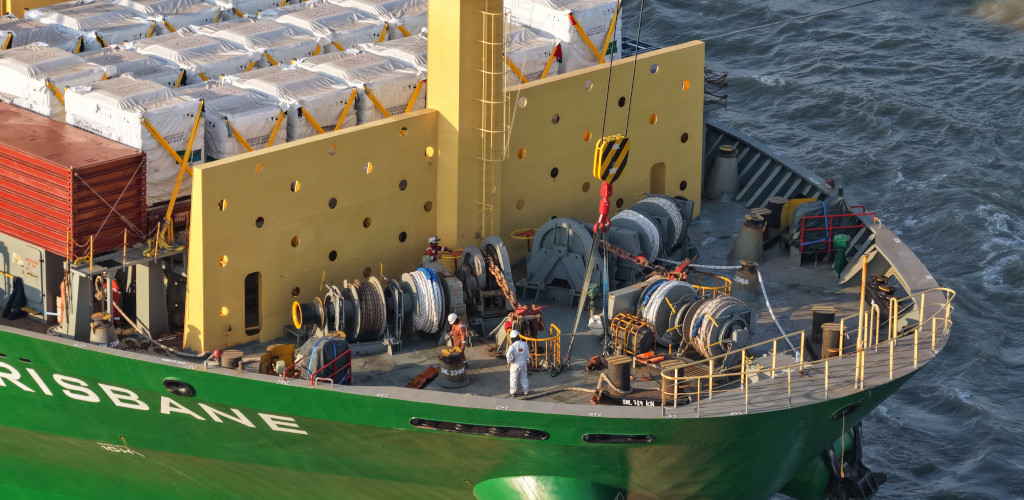
With all these checks complete, the units were then loaded on the 3,000-square-meter deck of the A-Class vessel AAL Brisbane, with cargo stored across the hatch covers.
 With the vessels prepared and at dock, loadout was conducted at Taicang in just days, and the cargo was ready to begin its more-than-5,000-mile journey to Eastern Australia. While much work had been put into developing TICT as a BESS breakbulk hub, the sector in the Australian city of Newcastle in New South Wales state has seen less development, leaving AAL to rely on its expertise to ensure the safe loading and onward transport of the units.
“Receiving the BESS units ashore was not without problems, as a lot of local legislation and approvals and stevedoring licenses did not cater for the sheer volume of IMDG Class 9 cargo being discharged in one sailing,” said Frank Mueller, general manager for AAL Australia and Oceania. “Special arrangements had to be made to discharge the BESS units directly to truck for transport to an off-site storage facility able to accommodate these volumes of dangerous goods.”
Alongside this, AAL had to ensure that berthing and operational restrictions were adhered to and the company worked closely with the terminals, stevedores and receivers to keep additional costs at a minimum.
A Burgeoning Market
Since this first shipment of 192 units was successfully delivered at the end of last year, the outlook for breakbulk demand related to BESS projects in Australia has gone from strength to strength.
“Looking ahead, the BESS market’s next growth wave is increasingly being shaped by data centers,” Zhou said, noting that “global demand for AI and data infrastructure is accelerating,” with the need for grid-connected energy storage and third-generation BESS units forecast to reach some 57 tonnes per unit from 2027 as a result.
“This will reinforce the critical role of specialist heavy-lift operators with vessels capable of handling this larger, heavier cargo,” he added.
AAL is working to meet this demand as it predicts that Australia’s data center sector “is entering a period of extraordinary growth,” with Australian Energy Market Operator (AEMO) predicting demand from data centers will rise sharply over the next decade as AI and hyperscale cloud infrastructure expand.
Given the steady base load power requirement of this infrastructure, battery storage is increasingly seen as the tool that helps unlock grid connections for these facilities rather than simply backing them up.
From a breakbulk perspective, the future remains complex as the specifications, size and handling of these units all rapidly evolve. Economies of scale suggest that batteries may grow even larger, and with that come further fire and safety risks. Regulatory changes likewise make forecasting vessel capacity complex for breakbulk operators as these units must transit different legislative regimes.
“New International Maritime Dangerous Goods (IMDG) requirements that came into force in January 2026 have mandated on-deck stowage for UN3536 BESS cargo,” Zhou noted. “While that will reduce the volume we can carry per voyage, we expect it to be offset by stronger freight yields.”
Despite these challenges, AAL expects early, proactive collaboration with regulators and infrastructure partners to deliver a genuine competitive edge. Breakbulk operators that invest in the required infrastructure, it says, can expect revenue per voyage to increase as the market develops.
AAL Shipping will be exhibiting at Breakbulk Asia 2026.
Top photo: The A-Class AAL Brisbane carries BESS equipment en route to Australia. Credit: AAL Shipping
Second: Jack Zhou. Credit: AAL Shipping
Third: Frank Mueller: AAL Shipping