
Industry Leaders Confront Practical Limits of Sustainability at THLG Event in Malaysia
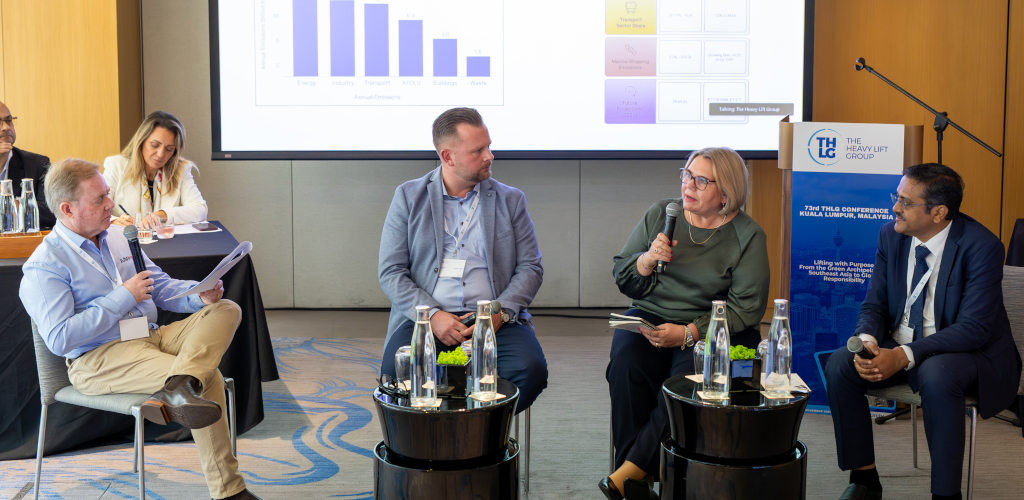
Sustainability is desirable for buyers and sellers of logistics services, but customer ambitions remain stubbornly sensitive to cost, according to a recent panel of The Heavy Lift Group (THLG) experts.
At the 73rd THLG International Conference in Kuala Lumpur, Malaysia, leaders from across the logistics sector gathered for a candid discussion on the realities of driving sustainability in the global transport industry.
Moderated by Darren Bennet, general manager at AAW Project Logistics, the panel brought together Erik Malmberg, traffic director at Begoma, Marianne Blechingberg, managing director of Hacklin Logistics, and Nilesh Sinha, director of Procam Logistics.
While all three speakers agreed that the industry is under growing pressure to decarbonize, they also found common ground in identifying additional costs as a limiting factor, with customers insistent on full transparency.
Data Driven Decisions
Malmberg emphasized the growing importance of reliable data; the data Begoma provides to customers provides the type of transparency that allows customers themselves to decide on sustainability, he said.
“We stay close to customers, suppliers and partners, offering alternative solutions so customers can choose what the best option is. There is always a difference in cost, of course, and that’s our main barrier to becoming greener within Europe. When we offer green solutions or greener solutions, it always comes back to the cost. And often, the cheaper solution is still chosen.”
Blechingberg highlighted how the sustainability challenge is as operational as it is financial. When customers began requesting Scope 2 calculations (which measure indirect greenhouse gas emissions from purchasing electricity, steam, heat or cooling) Hacklin invested in software which allows them to compare real emission costs to the initial offer.
“Transparency is becoming increasingly important; many of our key customers are assessing us on a regular basis or auditing us. So, it’s not only about providing the data; they are also really checking that we are working according to what we have promised and that all of the ESG parameters are followed.”
Logistics Options
Malmberg underscored how pressure from general society continued to move the dial towards greener solutions. “We are all required to do something; we know what’s happening with the climate and with the globe, so we all need to do something.
“One thing we are doing is switching to intermodal solutions. We increase the transit times of the shipments, but we decrease the carbon footprint. Of course, we do this with our customers. Often, they resist in the beginning, but later on when they see it works and when we speak to their customers, they see it can be done quite easily and at a lower cost.”
The challenges customers face in funding sustainability represented a recurrent theme in discussions. Even where RFQs include sustainability as a key requirement, speakers acknowledged that decisions would ultimately be driven by cost. “Actions taken to enhance sustainability therefore need to be chargeable as a service which does not have a cost impact on the bottom line,” said Blechingberg.
Sinha, of Procam, said discussions on sustainable transport should be viewed in the context of “the irony that… America has withdrawn from climate change commitment while Europe has diluted it,” with investor commitment to green goals also flagging.
In the context of global manufacturing and asset ownership, logistics providers also needed to remain realistic on their level of influence on planetary sustainability, added Sinha.
Cumulative change
Nevertheless, the power of accumulated of individual efforts should not be underestimated. “The planet has a limited natural capacity (about 20 gigatons) to absorb carbon each year, so everything we release into the environment adds to the cumulative burden,” he said. In India, road transport is one of the most significant and fastest-growing sources of emissions, contributing around 12-14% of total CO₂ emissions and nearly 80% of transport-related emissions.
“When you look at the bigger picture, you realize how small contributions can help. We looked at this logically as an organization. So to optimize decarbonization, we switched to India’s BS-6 vehicle standards, which has cut sulfur emissions from 30ppm to 5ppm, for example.”
The creation of a green corridor between Singapore and Rotterdam, port automation in Japan and India’s national logistics plan to control carbon emissions provided inspiring, practical examples of what could be achieved, added Sinha.
As a general proviso, he suggested that unless sustainability is considered as a KPI during the evaluation process, there is no incentive for companies to change. “Sustainability is currently on the liability side of the balance sheet. We need to convert this to an asset so it is on the investment side,” he concluded.
THLG is an exhibitor at Breakbulk events.
.jpg?ext=.jpg)



.png?ext=.png)









.png?ext=.png)







_3.png?ext=.png)
_1.jpg?ext=.jpg)








.png?ext=.png)
.png?ext=.png)
.png?ext=.png)