
China-Developed Transporter Designed for Heavy-Lift, Project Logistics Applications
By Leslie Meredith
Without legacy engineering constraints, a new “advanced” SPMT being developed by two Chinese companies offers reduced emissions and compatibility with existing hydraulic fleets.
From Issue 2, 2026 of Breakbulk Magazine.
As the project cargo sector intensifies efforts to decarbonize heavy transport operations, one category has remained particularly difficult to electrify: the self-propelled modular transporter (SPMT). Long dependent on diesel-hydraulic systems, SPMTs sit at the center of some of the world’s largest industrial and infrastructure projects, yet commercially viable zero-emission alternatives have been notably absent.
A Chinese technology company believes it has an answer.
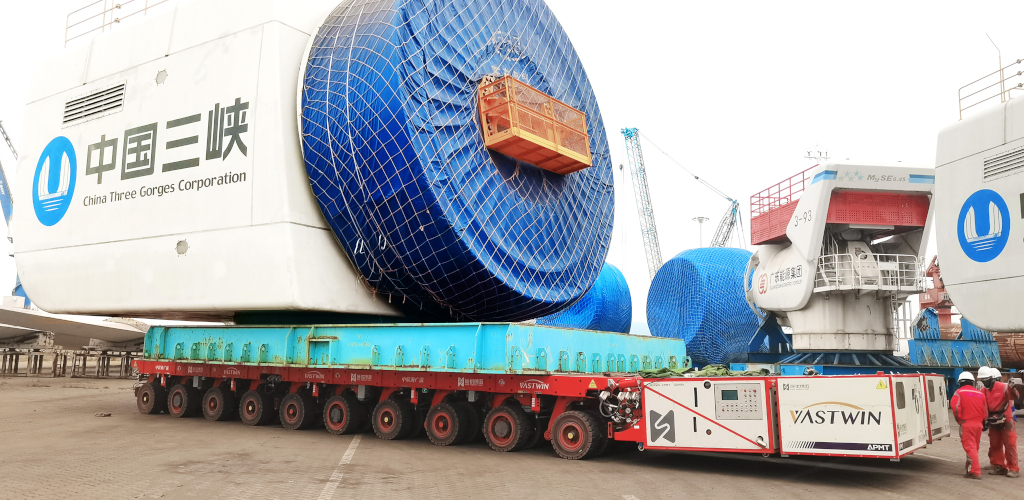
Founded in 2024 in Xuancheng, Anhui Province, Anhui SuperTransport Heavy-Load Robot Co., Ltd., has introduced the APMT (Advanced Power Modular Transporter), what the company describes as the world’s first fully electric-driven intelligent modular transport platform designed for heavy haul and project logistics applications.
The platform has received CE certification and is being codeveloped with Vastwin. Super Transport Robot is currently expanding international distribution partnerships for the APMT. The platform has already launched deployments in sectors including offshore wind, petrochemicals and port logistics in China.
No Stranded Assets
Now the company says it’s ready for the world. The SPMT market is highly competitive, led by two Germany-based companies, Scheuerle, part of the TII Group, and Goldhofer, along with Italian firm Cometto, part of the Faymonville Group. Notably, the APMT can work with existing SPMTs, ensuring no stranded assets.
“Importantly for fleet operators, the APMT has been designed to operate alongside conventional hydraulic SPMTs in mixed fleet configurations, allowing companies to introduce electric units incrementally rather than fully replacing existing assets,” Ziguang Jin, spokesperson for Vastwin, told Breakbulk in an exclusive interview.
Design Differentiators
Unlike conventional hydraulic-drive SPMTs, the APMT uses a proprietary integrated electric motor axle architecture powered by permanent magnet synchronous motors. By eliminating the traditional diesel power pack and large-scale hydraulic transmission systems, the platform significantly reduces mechanical complexity, maintenance requirements and operational emissions. Based on 1,500 annual operating hours, the company estimates that a single unit can reduce CO2 emissions by approximately 118 tonnes annually compared with a conventional hydraulic-drive SPMT.
The simplified electric architecture also reduces hydraulic pipework and mechanical connection requirements, which the company says can significantly lower labor and maintenance costs.
Freedom from Legacy Engineering
The design was made possible by starting with a clean-sheet electric platform rather than adapting legacy hydraulic products. As a new entrant without an installed fleet base to maintain, the engineering team was able to prioritize electrification from the outset. “As a new company, we had no legacy architecture to defend and no installed base to accommodate,” said George Ge, founder of Super Transport Robot.
The six-axle-line platform carries up to 255 tonnes and is equipped with a 400.61 kWh CATL lithium iron phosphate battery system operating at up to 700 volts. Dual-port fast charging enables the unit to reach 80% capacity in approximately two hours.
Beyond emissions reduction, the company positions the platform around operational efficiency. Independent electric drive systems remove extensive hydraulic pipework and reduce potential failure points, while operating noise remains below 65 decibels, which has become particularly important for urban infrastructure projects, ports and energy facilities operating under stricter environmental standards.
The timing aligns with increasingly stringent regulations focused on a path to zero carbon emissions. EPC contractors, port operators and specialized transport companies are facing growing customer scrutiny around Scope 3 emissions, ESG targets and low-emission project delivery requirements, particularly in Europe and parts of Asia. The APMTs provide verifiable metrics for reporting.
AI Today and Tomorrow
Today’s models incorporate AI-enabled functions including route planning, environmental monitoring, risk analysis and multi-unit coordination. “These functions are designed to improve fleet coordination and operational planning across complex project environments,” Jin said.
No company can afford to stand still in an evolving industry, and Anhui SuperTransport Heavy-Load Robot Co. is working on another world first: the self-driving APMT. Stay tuned as Breakbulk follows the company’s progress in future reporting.
Photo: The APMT carries a wind turbine for the Three Gorges project in Guangdong Province, China. Credit: Vastwin
.jpg?ext=.jpg)


.png?ext=.png)





.png?ext=.png)




_3.png?ext=.png)
_1.jpg?ext=.jpg)







.png?ext=.png)
.png?ext=.png)
.png?ext=.png)