SAL’s Tina Yi on Seizing China’s Project Cargo Opportunity

By Liesl Krog
China’s project cargo market is booming and Tina Yi, managing director of SAL China, is at the heart of it. She discusses the value of regional business expertise and why returning to China two decades was “the best decision ever.”
From Issue 4, 2026 of Breakbulk Magazine
(5-minute read)
Tina Yi never thought a moment at an airport would change the course of her life. In 2006, she arrived home from the UK for a visit and found her parents waiting for her. She was working for a British-based forwarder at the time, but seeing them made her reconsider where she wanted to build her life.
“I remember looking at them and thinking they were growing older, and I was not there to help. I made the decision to move back home right then and there,” she said.
As an only child, Yi wanted to be closer to her parents. She settled in Shanghai, where China’s industrial expansion was creating opportunities in shipping. Power plants, steel mills and petrochemical projects were getting built, driving demand for increasingly large and complex cargo movements.
Today, as managing director of SAL and JSI Alliance in China, she regards that decision as one of her most important choices. Her reason for coming home was personal, but the timing would prove important professionally.
Her path into shipping, however, began far away from China. After a first degree in marketing and economics at home, she wanted to study abroad, completing a postgraduate degree at the University of Surrey before choosing a master’s in international logistics at the University of Plymouth.
China had recently joined the World Trade Organization and Yi recognized the potential for shipping and logistics to grow alongside its economy.
While she had no immediate plans to return home, she saw shipping as an early indicator of changes in the global economy, where her initial interest lay. Studying the industry, however, quickly revealed how well it suited her personality.
“I found that shipping was a perfect match for me. It requires knowledge of the global economy, patient analysis and hands-on work. Its complexity was also very much part of the attraction,” she said.
After her master’s, she faced a choice between continuing toward a PhD or putting her knowledge into practice. A job offer from Eagle Freight in the UK gave her the opportunity to do the latter. Working first with containers and then some breakbulk cargo, she began learning how the trade she had studied operated on the ground.
When she returned to China, Shanghai’s ports and international connections made it a natural place to seek work. She moved into broking breakbulk cargo and handysize tonnage as China’s industrial projects generated more work and increasingly complex shipments.
“In the UK my work was mostly around importing containers from China, but now I found myself on both sides, and there were some massive projects taking place in China at the time,” she said.
The Curiosity Factor
 Among the companies she approached for freight rates was SAL. Its quotations puzzled her. “I kept thinking how they have such small vessels, much smaller than the handysize, so why the rate?”
When a chartering position became available, she applied. Asked at the interview why she wanted to join, she candidly explained that she wanted to understand why SAL’s rates were so high. She laughs as she recalls her answer, but her frankness proved no obstacle. SAL offered her the job.
She joined in 2007 and soon found the explanation. SAL’s vessels were specialized for heavy cargo and project shipments. Once she understood what they could do, the rates she had questioned made sense.
“Ultimately, I chose SAL and they chose me,” she said. Looking back, she believes she made the right choice at the right time. Nearly 20 years later, she leads SAL’s business in China.
“Heavy-lift shipping requires knowledge that takes years to acquire, and I have chosen to build mine within a company whose fleet and services have continued to expand. Each project is different and each has its own way to deliver,” she said. “I like the challenges and complexities. I found a space that I have been able to thrive in."
The work continues to hold her interest, requiring her to keep learning as projects, equipment and customer requirements change. Through the infrastructure and industrial projects she has worked on, she has also witnessed China’s economic expansion firsthand.
Reading the Market
For Yi, understanding China’s project cargo market starts with the policies directing its development. “China is a policy-driven market. No market moves faster. One policy shift can create a whole new industry within a year.”
The country’s five-year plans provide signals about where investment and demand are likely to emerge. Studying them helps companies identify opportunities and prepare their capabilities before projects reach the shipping stage. By the time a policy produces visible demand, she believes, the best-prepared companies will already have done their groundwork.
Preparation also requires regional knowledge. China’s scale does not make it a single, uniform market. The Yangtze Delta, northern China and the south have different industries, project requirements and business cultures, all of which influence how companies operate.
“You have to be able to bridge those differences. Having in-depth local knowledge is critical for success, including understanding local policies and business culture.”
Competition, she said, has intensified as Chinese capabilities have grown and customers have become more sophisticated. Yi’s task includes helping the head office in Germany understand these developments, identifying local opportunities and expanding SAL’s business in the region.
Geopolitical uncertainty has further complicated the market. “Supply chains are more complex, with more stakeholders than ever before. Ultimately, decisions are harder and more important than ever.”
Yi remains cautiously optimistic about demand, particularly across energy and industrial projects. Offshore wind operations and maintenance, floating wind farms, green methanol and ammonia projects offer opportunities, while renewable energy development also requires investment in grid and power infrastructure.
“The challenge is not whether the projects exist; it is how we deliver them faster, cleaner and in a way that works for clients, governments and communities,” she said. “That takes more than machinery. It takes trust, clarity and shared understanding.”
Exports of high-end Chinese equipment are another source of demand. Chinese engineering, procurement and construction contractors are undertaking overseas projects through what she describes as a greener, more selective “Belt and Road 2.0.” Data centers and semiconductor plants are also emerging as project cargo markets.
These developments have changed China’s place in the industry. Once a major importer of equipment, it has become an important source of equipment, expertise and shipping capabilities.
“Perhaps China missed the great maritime age of the last century. Twenty-five years ago, China was mainly a cargo market. After twenty-five years of fast growth, it is no longer just a cargo market. It has become a resource market too,” she said. “In its own way, China is opening its own great maritime era, and we are lucky to be right here, in the middle of it.”
For SAL, responding means understanding where its services are needed and maintaining relationships with customers whose requirements continue to evolve. Heavy-lift capacity is limited, and customers value the certainty of securing it. They have their own shorthand for this. “Our clients often refer to SAL as ‘Space Always Limited,’ or some say, ‘Service Always Luxury,’” she said.
That kind of reputation depends on relationships, and building them requires an understanding of how business is conducted locally. Yi compares mature Western markets to chess, with established rules and contracts.
“China is a developing market that has grown remarkably fast. Here the players have less accumulated experience to draw on and business is more like go — the board is open. Positions are still evolving, and it can take a little longer to build mutual trust at the initial stage,” she said.
“Neither is better or worse, simply different games. In China, trust-building is not a formality. It is the foundation, and once established, partnerships tend to be very durable.”
Growing Together
 Her colleagues at SAL have been equally important to Yi’s career. She credits the company’s inclusive culture with giving her room to develop her own approach in a predominantly male industry. “They allowed me to be myself and to play to my strengths rather than ask me to fit a template,” she said.
She hopes others will follow. “I would like to use my experience to encourage more women in shipping. This industry is entering its most fascinating decade. The energy transition is the biggest project cargo story of our generation and it needs new minds, especially female minds.”
Yi’s own route into leadership began on the operational side. She worked as senior chartering and project manager, handling large, complex projects for SAL’s heavy-lift fleet, before becoming managing director of SAL China in 2020 and JSI China in 2021.
Within her team, she describes herself as a safety net. Colleagues have room to work out their own solutions, knowing she is available to help. She also considers humility important.
“It does not matter how experienced a leader becomes; there is always more to learn about the market. It keeps changing, bringing new challenges and new solutions. I have been with SAL for almost 20 years and staying has never meant standing still,” she said. “I have grown with every new chapter.”
Away from work, she enjoys reading, going to the gym and traveling with her family. She is involved with her daughter’s school, sometimes giving lectures to parents and students about teenage issues. Family life includes her husband, their 15-year-old daughter, her parents and the family dog.
The support of her parents has given a different meaning to the decision she made at the airport. “I thought I was coming back to take care of them, but actually they are the ones taking care of me and supporting me behind the scenes, especially with how busy shipping can be,” she said.
Nearly 20 years on, she has no doubts about the choice. “I feel that I made the best decision ever to come back to China,” she said.
Tina Yi will be the keynote speaker at the Women in Breakbulk Asia Power Breakfast on Tuesday, Nov. 17 from 9am-11am. Reserve your ticket to Breakbulk Asia 2026.
Liesl Krog is a transportation journalist based in South Africa.
Top photo: Yi at home in China. Credit: Tina Yi
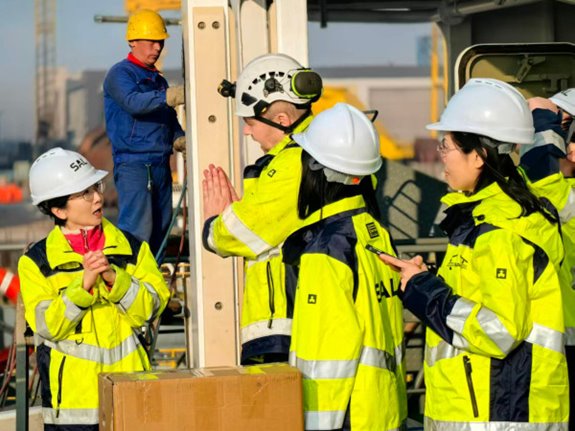
Second: Yi with her team on site in China. Credit: SAL
Third: Yi with her Women in Breakbulk colleagues at Breakbulk Europe 2026. Credit: Marco Wang