Project Forwarder Engineers Seamless Pipeline Delivery From Port of Shanghai
By Malcolm Ramsay
From Issue 3, 2026 of Breakbulk Magazine
(5-minute read)
As China continues to solidify its position as the global fabrication hub for critical energy infrastructure, the logistical challenges of moving oversized, sensitive breakbulk cargo from Chinese yards to remote project sites have never been more complex. For project forwarders, the margin for error is slim, with cargoes only growing in size and sensitivity as the scale of energy infrastructure grows.
Project logistics specialist deugro recently had to face many of these challenges when delivering a cargo of coated and concrete pipes with a combined volume of more than 14,600 cubic meters (cbm) from China for an offshore energy project in Argentina.
“One of the main challenges was coordinating the arrival of 2,265 pipes from two different suppliers using two different transport modes — trucks and barges — while working within strict vessel loading and discharge windows,” said Santiago Vaquero, sales and business development manager at deugro. “Any delay or mismatch in the delivery sequence could have disrupted loading operations and affected the overall project schedule.”
The project pulled on the firm’s resources across the globe, and was overseen by deugro Spain in collaboration with deugro China and deugro Chartering. The shipment, weighing over 10,000 tonnes, was contracted for transport from the Port of Shanghai to Argentina’s Port of San Antonio Este to support the offshore hook-up of two floating liquified natural gas (LNG) units stationed in the Gulf of San Matías.
Handling With Care
_1.jpg?width=575&height=383) Having secured the contract for this valuable transport, the first step for deugro was to ensure the appropriate teams were in place to begin the meticulous planning process.
Having secured the contract for this valuable transport, the first step for deugro was to ensure the appropriate teams were in place to begin the meticulous planning process.
“Flexibility was essential,” Vaquero said. “With more than 2,200 pipes arriving from multiple suppliers via truck and barge, maintaining alignment between cargo readiness, delivery schedules and the vessel’s loading window was a critical success factor. Given the large number of cargo components involved, even minor delays in production, dispatch or inland transportation could have affected the overall loading sequence and vessel schedule.”
The pipes measured 20 inches, 24 inches, 30 inches and 36 inches in diameter, making handling even more complex as operations had to be tailored to differing loads. Many of the pipes were fabricated with specialized coatings and materials, meaning extra care had to be taken during transport to avoid damage.
Given their sensitivity, the pipes required stringent protection measures, including defined requirements for support, lifting, stacking and allowable stresses, as well as custom-engineered lashing solutions to prevent pressure points and deformation.
To protect both the coating and structural integrity of the cargo, deugro developed handling and securing procedures based on a set of strict technical requirements that were gathered from the manufacturers, including criteria for support, lifting, stacking and allowable stresses.
“Custom-engineered lashing arrangements were designed to eliminate pressure points and minimize the risk of deformation,” Vaquero said. “Additional protective measures included the use of padded slings, certified wooden separators and soft-handling techniques throughout loading and discharge operations.”
Continuous visual inspections were also conducted by the teams from deugro China and Spain during cargo handling activities to verify the cargo remained in optimal condition at every stage of the transport chain.
Charter Challenges
As well as the challenge of moving thousands of tonnes of sensitive material, deugro also faced a tight completion window due to both dock availability in the Port of Shanghai and a constrained charter market, which added pressure on the schedule. However, the most critical factor in vessel selection was not the cargo volume, but the physical constraints at the discharge location.
The Port of San Antonio Este, located in Argentina’s Río Negro Province, serves as a strategic gateway for the region’s growing LNG exports but operates within an infrastructure-constrained environment. Unlike other major deepwater hubs, San Antonio Este operates with a narrow access channel and limited berth availability. The port’s primary commercial berth can only typically accommodate vessels up to 170 meters in length overall (LOA) with a maximum operational draft of 10 to 11 meters, heavily dependent on tide windows.
As a result, vessels must time their entry and departure within about two hours of high tide to navigate the channel safely, imposing strict limitations on vessel selection and rendering many standard bulk carriers unsuitable for entry.
“Due to the port’s draft and length overall limitations, only a very limited number of vessels in the charter market were technically suitable for the project and available within the required timeframe,” Vaquero said. “When approaching the market, deugro defined these parameters as non-negotiable requirements.”
The selected vessel needed to safely accommodate more than 14,600 cbm and over 10,000 tonnes of pipes while strictly complying with these operational restrictions, making optimized stowage vital.
Despite the challenging market conditions, deugro’s chartering department leveraged its extensive market knowledge and long-standing relationships with vessel owners to identify and secure the MV Billion Star.
No Margin for Delay
The Billion Star proved to be the ideal technical fit. A handysize bulk carrier built in 2004 and sailing under the Malaysian flag, the vessel features a length overall of some 176 meters and a beam of 29.4 meters, dimensions that allowed it to navigate the narrow channels of San Antonio Este where larger vessels could not.
With a summer deadweight capacity of about 33,500 tonnes, the Billion Star offered ample capacity for the 10,000-ton cargo while maintaining the stability required for heavy, high-value project goods. Managed by Wuhan Yidong Shipping Management and owned by Billion Treasure, the vessel’s availability and technical profile aligned perfectly with deugro’s non-negotiable scheduling and safety criteria.
However, securing the vessel was only the first hurdle. During the final preparation phase, updated cargo weight information necessitated lastminute modifications to the stowage plan. The team had to rapidly reinforce the lashing arrangements to maintain vessel stability and protect the cargo without delaying the loading window.
“To maintain the required timeline, deugro implemented continuous onsite supervision at the port of loading and maintained close communication with suppliers, terminal operators, vessel representatives and discharge port stakeholders,” Vaquero said, highlighting the importance of continuously reviewing data and maintaining flexibility in stowage engineering.
Thanks to this detailed sequential planning, real-time coordination and monitoring of cargo arrivals, deugro was able to consolidate the cargo efficiently and avoid bottlenecks. This enabled the team to avoid excess vessel idle time, berth congestion, unnecessary cargo storage and schedule disruptions, and as a result loading was completed within the planned three days with no delays or additional costs.
“The effectiveness of these measures was ultimately demonstrated by the fact that no cargo damage occurred during loading, ocean transportation or discharge,” Vaquero said, adding that preventing cargo damage was crucial as repairs, rework or replacement activities would have carried a heavy time penalty.
Supporting a New Energy Hub
Upon arrival in the Gulf of San Matías, the operational focus shifted to the precise execution of the discharge plan. The constraints that dictated vessel selection also governed the offloading process, with the discharge sequence synchronized with the tide cycles.
deugro’s local team worked closely with the vessel’s command to complete the discharge over eight days, maintaining real-time coordination throughout to ensure all stakeholders remained aligned.
The challenge extended beyond moving such a large volume of steel; it required maintaining strict segregation of pipe diameters while preserving the integrity of the protective coatings throughout the transfer to quayside storage. The pre-engineered lashing plans were reversed, utilizing soft-handling techniques to prevent any last-minute damage before the pipes entered the inland transport phase.
“Following discharge, the pipes were forwarded to various installation locations supporting both onshore and offshore infrastructure works,” Vaquero said, explaining that they will now be used as a “key part of the project’s gas transportation and connection infrastructure.”
Specifically, these giant conduits will be used to connect an onshore plant in San Martín to new floating offshore liquefaction capacity in the Gulf of San Matias. Spanning many kilometers, a significant portion of the pipes will help connect the Vaca Muerta shale gas reserves to the new Hilli Episeyo and MK II floating LNG (FLNG) vessels.
As detailed elsewhere in this issue, heavy-lift specialist Jumbo Offshore recently secured the contract to install the Hilli Episeyo and MK II units. Together, these major breakbulk operations are helping transform San Antonio Este into a pivotal energy hub, enabling Argentina to expand LNG exports to global markets and paving the way for a new wave of breakbulk projects across the region.
“This is not an isolated project; It is part of a course we have been building with planning [and] clear rules,” said Andrea Confini, secretary of energy and the environment in the Argentine government. “Río Negro is assuming a central role in national energy development, and the provincial government has the responsibility to ensure that this process translates into jobs, infrastructure, income and real opportunities."
On the Breakbulk Live Stage at Breakbulk Americas 2026: The US LNG Buildout — Energy Security and the Next Wave of Projects. Tuesday, Sept. 22, 11:30am - 12:15pm
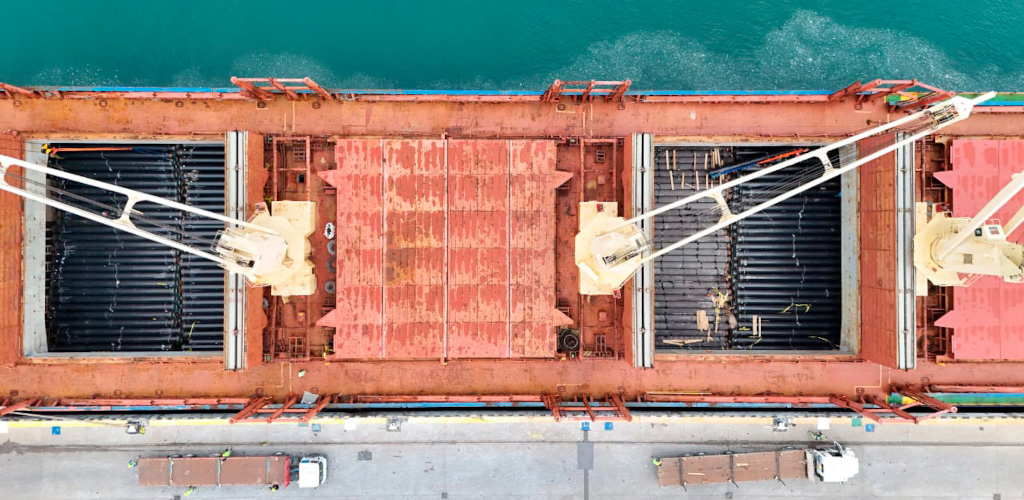
Top photo: Aerial view of the loaded cargo holds and trucks. Credit: deugro
Second: Unlashing and hooking of the pipes. Credit: deugro
.jpg?ext=.jpg)


.png?ext=.png)






.png?ext=.png)







_3.png?ext=.png)
_1.jpg?ext=.jpg)








.png?ext=.png)
.png?ext=.png)
.png?ext=.png)