Field Testing of Mixed Formations at China’s Yangjiang Offshore Wind Base
By Leslie Meredith
At the Yangjiang Offshore Wind Base in China, field testing of mixed formations combining all-electric with diesel-hydraulic units lets fleet owners reduce cost and maintenance without scrapping diesel units.
From Issue 4, 2026 of Breakbulk Magazine
(5-minute read)
At the Yangjiang offshore wind equipment base in Guangdong, China, a fleet of all-electric Advanced Power Modular Transporters (APMTs) spent 11 months working alongside diesel-hydraulic self-propelled modular transporters (SPMTs). Between October 2025 and September 2026, the electric fleet completed some 900 production moves of nacelles, tower sections, hubs and jacket structures for Hydropower Fourth Bureau (Yangjiang) Marine Equipment’s fabrication program. Loads ran from 80 to 560 tonnes, over distances of 0.2 to 7 kilometers.
In the largest formation, 20 electric axle lines and 20 conventional hydraulic axle lines carried a wind turbine and jacket in a single formation. A meter from the electric drive units, the sound level was 65 decibels, about the level of normal conversation. The diesel units in the same formation measured 100 decibels at the same distance.
On a yard where riggers walk beside the load for every meter of every move, that 35-decibel gap changes how a crew gives instructions and how safely it works.
The transport contractor’s crews tracked energy use, synchronization and maintenance across both fleets. Their results show fleet owners what APMTs cost to run and how they work with existing diesel SPMTs.
Built Electric From the Start
Most electric SPMT operations to date have used conventional hydraulic platforms with an electric power pack in place of the diesel engine. The APMT from Super Transport Robot (STR) was designed as an all-electric transporter from the ground up.
Its published specification (Breakbulk Magazine, Issue 2, 2026) runs to a six-axle-line platform with a 255-ton payload, a 400.61 kWh CATL lithium iron phosphate (LFP) battery at 700 volts, dual-port fast charging to 80% in about two hours, permanent-magnet synchronous motors with independent electric drive and CE certification.
A fabrication and marshaling yard is close to the ideal duty cycle for that design. Moves are short and repetitive, machines return to the same base every night and crews on foot handle precision cargo for entire shifts. At Yangjiang, peak construction season adds heat, high humidity and salt-laden coastal air. In that setting, zero exhaust at breathing height and a fixed overnight charging point become operational advantages.
Cost per Move, Side by Side
On a documented 6-kilometer move of a 310-ton load, the electric formation used 140.8 kWh. The transport team puts diesel consumption for the same move at 70 to 80 liters. At local energy prices, the electricity cost roughly a quarter of the diesel bill.
The carbon numbers point the same way. Seventy-five liters of diesel emits roughly 200 kilograms of carbon dioxide; the same move’s electricity, at Chinese grid factors, carries roughly 75 to 80 kilograms, a reduction of around 60%. STR quotes around 118 tonnes of CO2 saved per APMT per year at 1,500 operating hours.
Running Alongside Diesel
For fleet owners, the buying question is whether going electric strands the diesel assets already on the books or upgrades them formation by formation.
The crews found that the most sensitive case was the opposite of what most people expect: light loads under 100 tons spread across many electronically synchronized axle lines, where they are hardest to keep in step. The electric motors’ instant torque means the APMTs naturally want to pull away faster than the diesel units when starting, so the team taught them to follow.
A multi-motor synchronization control senses the diesel units’ start acceleration and matches it. With that tuning in place, speed, steering and lift in combined formation ran smoothly, the crew reported. The same instant torque gave fine low-speed control when positioning jackets onto barge decks or alignment pins.
“The most convincing part of the Yangjiang test was that we didn’t have to change our standard operating procedures,” Dafang Hui, the chief field engineer for Zhong Lian Hai Guang Ying Project Logistics Co., Ltd. (Vastwin), the project’s transport team, said. “The APMT moved in perfect tandem with our conventional diesel fleet. It gave us the extra payload capacity and zero-emission benefits without requiring us to scrap our existing equipment. That ‘plug-and-play’ compatibility is what makes electrification scalable for fleet owners.”
Maintenance Without Downtime
Ask the transport team what separated the two fleets day to day and the answer is maintenance. The APMT’s routine checks of fault codes across the battery, motor and control systems, coolant and oil levels, and a motor cooling filter are mostly software and inspection work, done in the gaps between moves. For the diesel units, maintenance means stopping the machine and stripping components. With less hydraulic pipework on the APMTs, technicians also reported zero hydraulic leaks from the electric units.
For 11 months the routine never changed: work the day, charge once, work the next. Battery management became second nature to the crews the way fuel management used to be, except the charging point now sets the timetable.
The Verdict From the Yard
Crews unanimously supported the integration of electric units. “Once you’ve driven the electric ones, you don’t want the diesel back. It costs less to run, it’s quiet enough to talk normally beside the load, and new hands pick it up fast,” Zhongyang Zhao, crew leader for the project’s transport team, said. “Our electric lines run in the same formation as the diesels, and the whole train steers and lifts as one machine.
“And this is no pilot. The units are out working every day. Anyone who wants to see what they can do is welcome to come to the site and watch.”
The project owner’s side reached the same conclusion. “We judge transport equipment by what a move costs us, and on that measure the electric units have proved themselves: the energy cost per move is a fraction of what the diesel units burn,” Mr. Zang, site project manager for the project owner Hydropower Fourth Bureau (Yangjiang) Marine Equipment Co., Ltd., said. “Over some 900 moves they worked inside our existing hydraulic fleet and got on with the program.
“What we would ask for next is simple: a bigger battery, more intelligence on board and obstacle avoidance above all.”
The owner’s requests for more battery capacity and obstacle avoidance point to what STR is testing next, Zinguang Jin, spokesperson for Vastwin and STR, said.
Electric heavy transport reached European ports this year too. In August, Osprey, operator of the U.K.’s largest SPMT fleet, ran the country’s first electric SPMT operation in a port. In September, Mammoet moved a 1,700-ton monopile at Denmark’s Port of Rønne on electric SPMTs, avoiding an estimated 25,000 to 30,000 liters of diesel on a single move. Both were single moves under close watch.
Roughly 900 production moves across 11 months of daily duty is an intensity and a duration no electric heavy-transport program outside China has yet matched in published service. The APMT proved itself inside a working fabrication program, under challenging conditions and a tight schedule.
That record arrives as Singapore, South Korea, Japan and Vietnam tighten carbon and port noise rules, pushing EPCs and transport contractors to cut emissions without giving up lifting capacity.
Fleet owners, EPCs and project teams who want to see electric heavy transport under full load are welcome on site, Jin said. STR, for its part, is ready to take the APMT from this yard to projects worldwide.
The boom in manufacturing and fabrication activity across Southeast Asia will be a key talking point in a panel session at Breakbulk Asia 2026. Megaproject Asia: Delivering the Next Phase of Industrial Growth will take place on the Breakbulk Live Stage on Wednesday, Nov. 18 from 2:05pm-2:50pm.
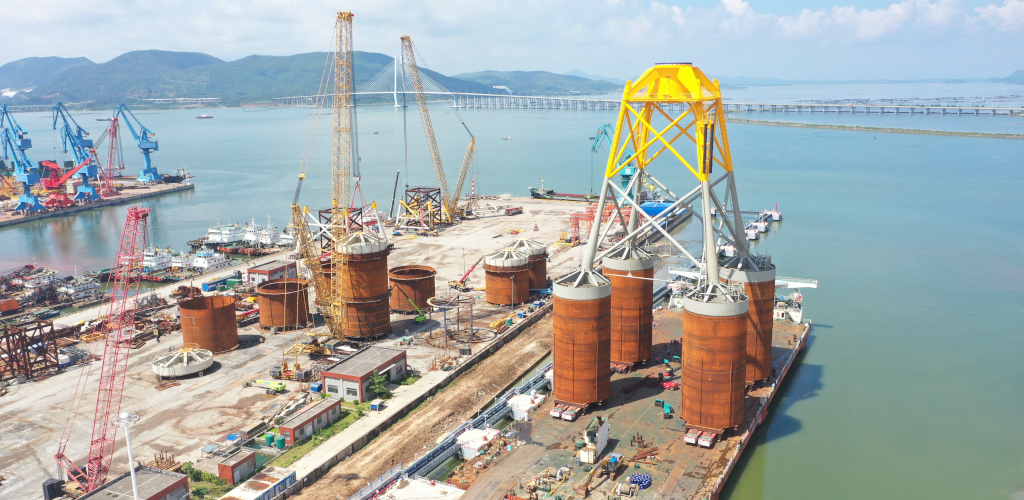
Top photo: Building foundations at the Yangjiang yard. Credit: Vastwin