Why Breakbulk Can’t Ignore a Disruption in Malacca, Singapore or Taiwan
By Amy McLellan
Disruption around the Straits of Malacca, Singapore and Taiwan would have major repercussions for global trade. Industry experts from Maersk Project Logistics, Gulftainer and Global Resources Partners examine what it could mean for breakbulk.
From Issue 4, 2026 of Breakbulk Magazine
(5-minute read)
The global shipping system is increasingly vulnerable to disruption. From drought-induced restrictions in the Panama Canal to conflict in the Middle East, recent years have shown how quickly the closure or disruption of a strategic maritime chokepoint can ripple through tightly interconnected supply chains.
While the Middle East often dominates contingency planning, Asia is home to several waterways whose disruption could have equally far-reaching consequences. Three stand out in particular: the Strait of Malacca, the Singapore Strait and the Taiwan Strait. A prolonged closure or serious blockage of any of these routes would pose a major challenge for global trade and give executives in the breakbulk and project cargo sectors plenty to worry about.
“The world would quickly discover that Malacca, Singapore and Taiwan are not three separate waterways,” says Mehmet Öğütçü, chairman of Global Resources Partners and the London Energy Club, and a former diplomat and International Energy Agency (IEA) executive. “Together they form the circulatory system of the Asian economy.”
Disruption here could take many forms: a collision blocking part of the channel, a cyberattack disabling port and navigation systems, or a regional military confrontation prompting insurers to withdraw cover.
“For me, the question isn’t ‘What event could close a strait?’ but ‘What could make using a strait sufficiently difficult or risky that normal shipping patterns start changing?’” says Rafael Vicens, head of Maersk Project Logistics IMEA. Risks could range from geopolitics, particularly around Taiwan, to navigation constraints, a quarantine or more traditional maritime risks such as collision and grounding, as well as cyber and technology-related threats.
According to Vicens, a strait doesn’t have to be physically closed to cause significant disruption. “As we are seeing on the Bab el-Mandeb and Hormuz, if the security risk becomes too high, vessels may already start avoiding an area, insurance conditions can change and established shipping patterns can quickly be affected.”
Risks Laid Bare
 The Malacca and Singapore straits connect the Indian Ocean with the South China Sea and the wider Asian manufacturing ecosystem. In the first half of 2025, an average of 23.2 million barrels of oil and petroleum products passed through the Strait of Malacca each day, alongside large volumes of LNG, coal, iron ore, food, chemicals and manufactured goods.
“More than 102,500 ships transited the Malacca Strait in 2025, which gives an indication of the scale involved,” says Vicens. “Alternative routes exist, particularly through the Indonesian archipelago, but rerouting means additional distance, time and cost, while potentially transferring congestion to other waterways.”
Singapore, as a global center for refining, bunkering, container transshipment, commodity trading, marine insurance and shipping finance, magnifies the importance of the route. A disruption here would affect not only where ships could sail, but also the availability and cost of bunkering, port services, logistics and other critical elements of the maritime ecosystem.
Meanwhile, an estimated US$2.5 trillion worth of goods — more than one-fifth of global maritime trade by value — passed through the Taiwan Strait in 2025, with the island hosting some of the world’s most important semiconductor, electronics, automotive and advanced-manufacturing clusters.
“The immediate crisis would be psychological as much as physical,” says Öğütçü. “Markets would not know whether the disruption would last three days, three weeks or three months and that uncertainty would produce panic buying, hoarding and speculative price movements.”
Tankers would likely slow, container vessels would anchor outside ports and LNG carriers would change direction. Freight rates would jump, and oil and gas prices would surge. Longer diversions would increase fuel, freight and insurance costs and reduce vessel availability while alternative ports could quickly become congested.
Regional Impact
China would suffer on both the import side, particularly for energy and other strategic commodities, and on the export side, as manufacturers depend on maritime routes to reach overseas markets. Beijing has built pipelines, railways, ports, strategic storage facilities and Belt and Road corridors partly to reduce its dependence on vulnerable sea routes. But the China-Myanmar oil pipeline, which bypasses Malacca, carries only a small fraction of China’s crude-import needs. Railways, meanwhile, cannot match the volumes moved by sea.
Taiwan depends on the sea for almost all its imported energy. Chip plants require uninterrupted electricity, ultrapure water, chemicals, industrial gases and spare parts. Finished chips can be flown out, but the thousands of materials needed to make them cannot all be airlifted in.
Japan and South Korea both maintain substantial strategic petroleum reserves, giving them some buffer against an energy shock. They could also seek alternative supplies and routes across the Pacific. Their factories, however, rely on production networks spread across China, Taiwan, Korea and Southeast Asia, leaving them vulnerable to shortages.
A prolonged interruption to Taiwanese and South Korean semiconductor production could therefore have consequences far beyond Asia, disrupting automobile production, telecommunications equipment, data center construction and other technology-intensive industries worldwide.
Alternative Routes?
The world would not be completely trapped. The Sunda Strait, between Sumatra and Java, provides the nearest substitute for Malacca, but it is narrower, shallower and unsuitable for some fully loaded tankers. It could absorb additional traffic, but not the full volume normally passing through Malacca.
The deeper Lombok Strait would be the main alternative for large tankers and bulk carriers. Ships could sail north through the Makassar Strait and continue into the western Pacific. The route is viable but longer, meaning more fuel, higher costs and less effective capacity in the global fleet. To avoid the Taiwan Strait, vessels could pass through the Luzon and Bashi channels and along Taiwan’s eastern coast, though a military conflict in the area could see insurers exclude the entire region.
Overland alternatives would become more important. China would maximize oil and gas imports through Russia, Kazakhstan, Central Asia and Myanmar, although some of those regions face their own conflict-related disruptions. Eurasian railways would carry more machinery, electronics and high-value goods.
But maritime trade operates on a scale that land transport cannot match. Pipelines carry only specific commodities and cannot suddenly be expanded. Railways face different gauges, capacity constraints and political risks. New projects such as the Kra Canal or the proposed Thai land bridge would take many years to fill the gap.
According to Öğütçü, the shock “could be larger than the combined effects of the Suez blockage, the Red Sea attacks, the Ukraine war and the pandemic-era semiconductor shortage because it would strike energy, manufacturing, shipping and technology at the same time.”
The lesson is that redundancy planning should be in place now. Governments around the world must treat maritime resilience as part of national security rather than transport policy. Whether it’s diversified energy stocks, east-facing ports, protected undersea cables or coordinated plans for keeping essential shipping lanes open, resilience requires multiple layers of protection and redundancy.
Impact on Project Cargo
For large and heavy cargo such as turbines, transformers, generators and industrial equipment, the concern is that they cannot easily be moved by other means or through alternative routes.
For major construction, energy and industrial projects, the bigger problem is that one overdue piece of equipment can delay an entire project. When it comes to disruption impacting Taiwan, for example, it is interruption to manufacturing and exporting the smallest components — semiconductor chips — that could then negatively impact some of the biggest items: wind turbines, generators and processing equipment. One critical component arriving late can matter more than hundreds of components arriving on time.
“Project cargo behaves differently from standard containerized cargo,” says Vicens. “Moving a heavy transformer, pressure vessel, turbine component or oversized module requires engineering around the vessel, ports, lifting arrangements, draft restrictions, inland infrastructure and ultimately the construction schedule. If the maritime route changes, you potentially have to reconsider several pieces of that puzzle.”
Unlike oil, which can be rerouted even if that route takes longer, project cargo needs an alternative route that also works with the vessel, ports, infrastructure and project schedule. “That’s what makes major chokepoint disruption particularly relevant for project logistics,” says Vicens.
Understand the Priorities
The immediate priorities are straightforward, he says: protect people, understand the risks and then protect continuity of the cargo flow. The industry should look at alternative maritime routings, different gateways, vessel deployment and, where appropriate, combinations of ocean, road, rail or air.
“For major projects, critical cargo should be identified early, routing constraints understood, and realistic alternatives considered before they’re needed,” says Vicens.
Communication matters too. “Customers don’t just need to know where their cargo is. They need to understand what disruption means for their project,” he says, noting that a seven-day transportation delay does not automatically equal a seven-day project delay. “The real question is whether the delayed cargo sits on the project’s critical path.”
Lessons From Hormuz
In 2026, Hormuz showed that a waterway doesn’t need to be closed; the threat alone can affect vessel movements, shipping patterns, insurance and freight costs.
Still, there are differences: Hormuz is an access point into and out of the Arabian Gulf, but Malacca and Singapore connect two major maritime regions. Taiwan, meanwhile, sits alongside one of the world’s most important technology ecosystems.
“We shouldn’t assume that the routes that worked yesterday will always be available tomorrow,” says Vicens. Resilience, he adds, does not mean expensive backup plans for every shipment. “It means understanding where you are exposed, which cargo is genuinely critical and what realistic alternatives are available.”
The industry has proven its capacity to adapt and find solutions to unexpected problems, whether that is drought in the Panama Canal or COVID-19 restrictions.
“As we have seen this year with the ongoing disruption in the Strait of Hormuz, this is an industry that is flexible and experienced at solving problems on behalf of its clients,” says Farid Belbouab, Group CEO of Gulftainer, which recently expanded into Southeast Asia with a strategic investment in the Suksawat Terminal, just south of Bangkok.
“In the UAE, we have pivoted our operations, quickly establishing new inland logistics corridors in order to keep trade moving through the region, with the number of containers we’re handling at Khor Fakkan jumping from 2,000 a week to 75,000 a week. Further expansion is planned. As proven in recent years, from COVID to recent conflicts, this is an industry that is resourceful and resilient, and customers can trust us to keep trade moving.”
How the industry is responding to growing pressure at critical maritime chokepoints will be the focus of a panel session at Breakbulk Asia. Fragmentation, Flows and the Future of Trade: Navigating Asia’s New Trade Map will take place on the Breakbulk Live Stage on Wednesday, Nov. 18 from 12:00pm to 12:50pm.
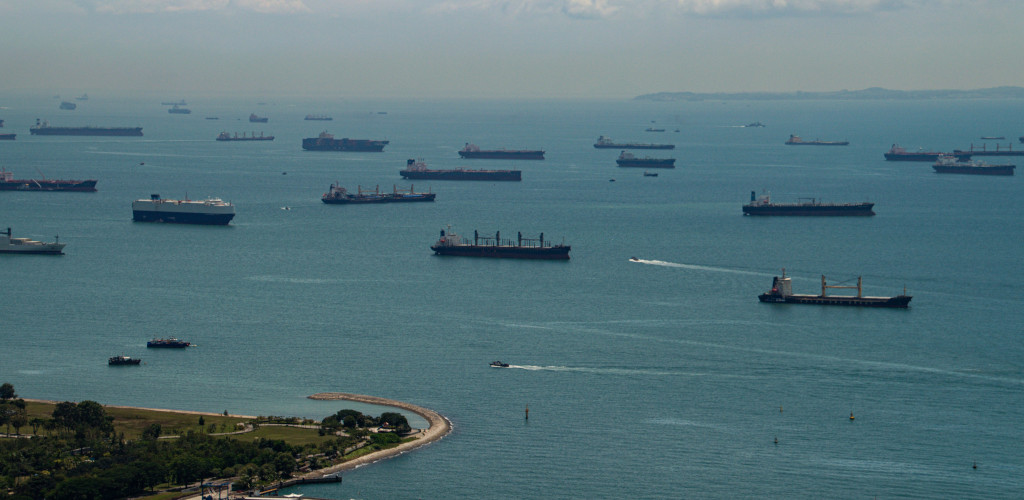
Top photo: Aerial view of ships anchored in the Singapore Strait. Credit: Saksham Vikram
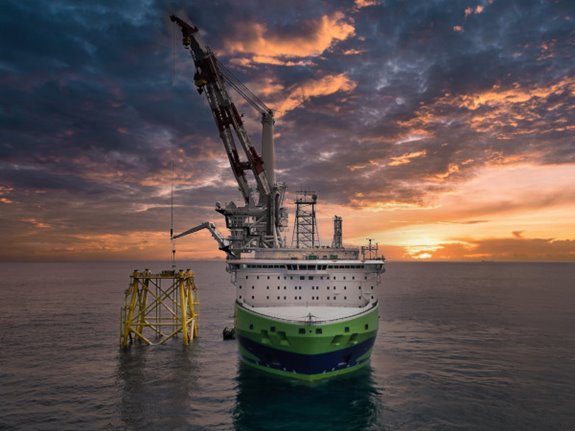
Second: The installation vessel Green Jade carries out work at the Hai Long offshore wind project inside the Strait of Taiwan. Credit: Hai Long Offshore Wind