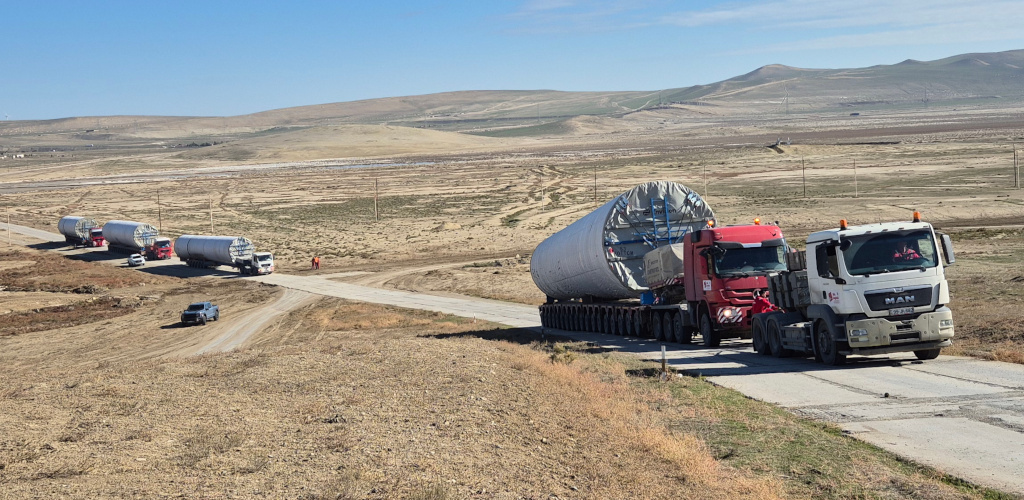
Globalink Engineers a 10,500-kilometer Operation Across Eurasia
By Simon West
Siddique Khan, CEO of Globalink Logistics, takes us inside a remarkable cross-continental operation to deliver wind turbine components more than 10,000 kilometers from China to Azerbaijan, highlighting the growing importance of the Trans- Caspian transport corridor in supporting the global energy transition.
From Issue 3, 2026 of Breakbulk Magazine
(2-minute read)
 Q: Can you start by giving us an overview of the project, its objectives and what made it such a significant undertaking?
SK: The project involved transporting 115 wind turbine blades, each measuring 85 meters in length, together with 109 tower sections, 24 nacelles and hubs from manufacturing facilities in Yangzhou and Jinchuan, China, to the Gobustan and Khizi wind farms in Azerbaijan. This project is particularly significant as it involved what is likely one of the longest overland transport operations for wind turbine generator components, covering some 10,500 kilometers from China through Central Asia, across the Caspian Sea, and finally to a highly challenging project site in Azerbaijan.
Q: What equipment and planning were required for a project of this scale?
SK: A specialized fleet including heavy-duty prime movers, blade trailers, blade lifters, tower trailers and hydraulic modular axle trailers was deployed throughout the project along with sea-river class vessels and pontoon-type barges for cross-Caspian shipping. Extensive engineering and route surveys were carried out before transportation began, with bridges, roads and other infrastructure assessed and reinforced where necessary to accommodate oversized cargo.
Q: What were the biggest challenges the project faced and how were they managed?
SK: The logistics operation faced a number of challenges, including extreme weather across multiple climate zones, earthquakes in China’s Xinjiang region resulting in route deviation, historic flooding in Kazakhstan that damaged infrastructure, and complex customs and permit requirements across several countries. A dual-border strategy was adopted, using the Dulata crossing for towers, nacelles and hubs, while Khorgos handled the wind turbine blades. The Caspian Sea crossing was completed using an RSD-59 project vessel for heavy components and pontoon barges for the blades.
Q: Why use two different border crossings, and what benefits did that bring?
SK: Until mid-2024, Khorgos was the only practical border crossing for oversized wind turbine components moving from China into Kazakhstan. With several major renewable energy projects starting simultaneously, relying on a single crossing became a significant risk to project schedules. To address this challenge, Globalink took the initiative to develop a dedicated bypass for oversized cargo at the Dulata (China)-Kolzhat (Kazakhstan) border crossing. This required obtaining special government approvals, completing engineering and infrastructure improvements, and making substantial investments specifically for this project.
The new crossing significantly reduced congestion at Khorgos border, improved operational flexibility and ensured the uninterrupted movement of oversized cargo. Beyond supporting this project, it has strengthened regional logistics infrastructure and created additional capacity for future heavy-lift and industrial projects.
Q: How did the earthquake in China and flooding in Kazakhstan affect your original plans?
SK: In China, the earthquake damaged a key bridge on the planned route, requiring us to redesign the transportation methodology using blade lifters and controlled double handling. In Kazakhstan, widespread flooding rendered the original route unsafe, so we engineered an alternative international route through Uzbekistan before re-entering Kazakhstan. Despite these unforeseen challenges, our engineering and operations teams rapidly developed practical solutions, allowing the project to continue without impacting the EPC contractor’s overall construction schedule.
Q: Looking ahead, what role do you see the Trans-Caspian corridor playing in the renewable energy sector, and do you expect demand for large-scale wind energy logistics projects in the region to continue growing?
SK: The Trans-Caspian International Transport Route (Middle Corridor) is becoming one of Eurasia’s most strategic logistics corridors for renewable energy projects. As countries across Central Asia and the Caucasus accelerate investments in wind, solar, green hydrogen and power infrastructure, demand for specialized heavy-lift logistics will continue to grow.
One of the industry’s biggest challenges, however, is the shortage of specialized heavy transport equipment required to move oversized wind turbine components across the Middle Corridor. Recognizing this early, Globalink has made significant investments in heavy transport assets and engineering capabilities to help meet the region’s growing demand. Combined with our 30-year regional presence and extensive network across Central Asia and the Caucasus, these investments position Globalink to deliver reliable, efficient and integrated logistics solutions for the next generation of renewable energy projects.
Check out more great transport projects from around the world in the latest issue of Breakbulk Magazine.
Photo credit: Globalink
.jpg?ext=.jpg)

.png?ext=.png)



.png?ext=.png)


_3.png?ext=.png)
_1.jpg?ext=.jpg)




.png?ext=.png)
.png?ext=.png)
.png?ext=.png)